Skills books › Home
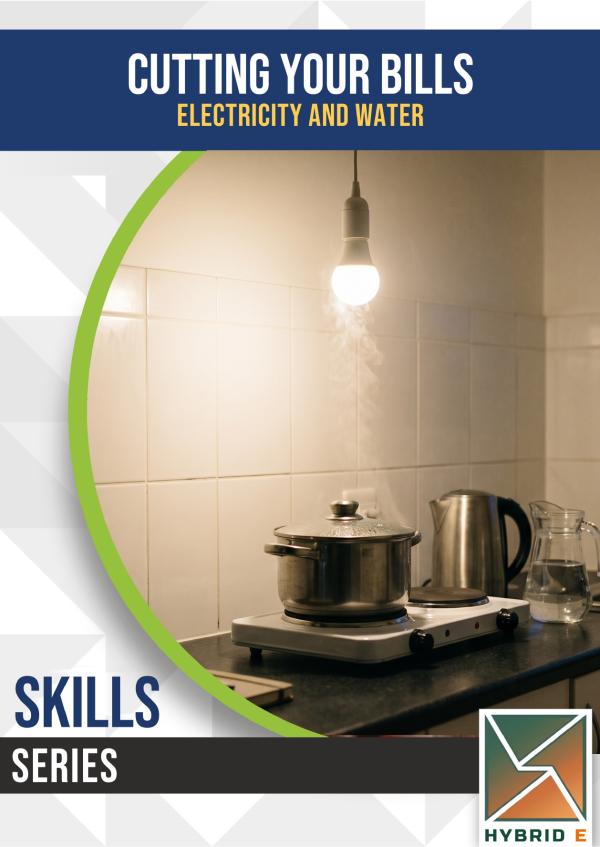
Cutting Your Electricity and Water Bills: Meters, Geysers, Appliances and Leaks in South Africa
Hybrid Learning Solutions · e-book
R149 incl. VAT
Read in any web browser, or in the HybridE app on Android.
About this book
A practical, South African guide to understanding and cutting household electricity and water bills, for families on prepaid electricity, households on municipal accounts, tenants, pensioners and anyone who has ever stared at a bill and wondered where the money went. Twelve chapters follow a family of five on prepaid in Soshanguve, a tenant in a flat in Athlone, and a pensioner in Kimberley facing a large catch-up water bill, with advice from a former municipal water and energy officer in Polokwane: kilowatt-hours, kilolitres, block tariffs and fixed charges; reading prepaid, dial and water meters and keeping a meter log; watts × hours and where the power really goes; the geyser, its thermostat, blanket, timer and emergencies; LEDs, energy labels, fridges and standby; cooking, heating and cooling for less, and the deadly danger of burning fuel in a closed room; the overnight meter leak test and the toilet dye test; using less water, grey water and restrictions; buying prepaid electricity safely, meter messages, ghost vendors and illegal connections; checking an account, querying and disputing a bill and paying the undisputed part; free basic services, the indigent register, rebates, tenants and shared meters; and solar water heaters, heat pumps and honest payback. Every calculation is worked, from a kettle's monthly cost and a dripping tap's litres to a catch-up bill spread over eight months and a household savings plan that saves R683 a month. Tariffs, free basic services, rebates and the rules on accounts and disputes are taught in general terms, dated, so you always check with your municipality or Eskom. 26 diagrams and photographs, worked examples, practice exercises with answers, and a savings file: a bills checklist, meter log, appliance cost list, geyser check, standby hunt, cooking and heating plan, leak check, water-saving plan, prepaid buying record, account check and dispute letter, help checklist, household savings plan, a glossary, where to get help, and 144 Exam prep questions. A Skills Series title. No appliance, meter, vendor or installer brands are named or recommended. Lecturers: a free Facilitator Guide (session plans built around a savings file, safe practical work with the college's meters, no opening meters or geysers in class, teaching notes and every answer) is available to colleges registered with HybridE. To register your college, contact Thandeka on 073 431 6763.
What is inside
- Chapter 1: Understanding Your Bills
- Chapter 2: Reading Your Meters
- Chapter 3: Where the Power Goes
- Chapter 4: The Geyser
- Chapter 5: Lights, Appliances and Standby
- Chapter 6: Cooking, Heating and Cooling for Less
- Chapter 7: Finding and Fixing Water Leaks
- Chapter 8: Using Less Water
- Chapter 9: Prepaid Electricity: Buying Safely
- Chapter 10: Municipal Accounts and Disputes
- Chapter 11: Help, Tenants and Pensioners
- Chapter 12: Bigger Savings and Your Plan
- Appendix
Free guides from this book
Read an extract
Chapter 1: Understanding Your Bills
The one thing
You pay for kilowatt-hours and kilolitres. Know what one of each costs you this month, and every saving in this book becomes a rand amount you can count. §1.3 shows how block tariffs work.
What You Pay For
Every household’s electricity and water bill is made up of a few parts:
- electricity used, in kilowatt-hours (kWh): a kettle running for half an hour, a geyser heating water, a fridge humming all day;
- water used, in kilolitres (kL): showers, toilets, washing, the garden;
- fixed charges on many accounts: a monthly amount for the connection or service, paid whether you use a lot or a little;
- sanitation (sewerage), often worked out from your water use;
- on a municipal account, also property rates and refuse removal, which this book does not try to reduce;
- VAT at 15 % on most of these.
Who sells it. Most households buy electricity from their municipality, which buys it from Eskom; some buy directly from Eskom. Water comes from the municipality. Prices are set in tariffs, which change every year, usually on 1 April (Eskom) or 1 July (municipalities). For 2026/27, Eskom’s direct tariffs rose by about 8.8 %, and the average approved for municipalities was about 9 %; your municipality’s own increase may differ.
Units: Kilowatt-hours and Kilolitres
Electricity. A watt measures how fast an appliance uses electricity; a kilowatt is 1 000 watts. A kilowatt-hour is 1 kilowatt used for one hour:
- a 2 000 W kettle boiling for 30 minutes uses 2 kW × 0.5 h = 1 kWh;
- a 10 W LED bulb on for 100 hours uses 0.01 kW × 100 h = 1 kWh.
Chapter 3 shows how to work this out for every appliance in your home. Water. A kilolitre is 1 000 litres: about 12 full baths, or 100 buckets of 10 litres. A household of four can easily use 20 kL or more a month.
Block Tariffs and Fixed Charges
Many municipalities use inclining block tariffs for electricity and water: the first units each month are cheaper, and each further block costs more. The aim is to keep basic use affordable and make heavy use pay more.
What this means:
- using less saves more than you expect: the units you cut come off the most expensive block first;
- on prepaid, the blocks usually reset at the start of each month, so the first units you buy each month are the cheapest and later purchases cost more (ask your municipality how its blocks work);
- fixed charges do not change with use, so on a low-use month they are a bigger share of the bill.
Prices and blocks differ between municipalities and change each year. Find your own tariff on your municipality’s website or account, and write it in your savings file with the date.
Worked Example 1.1 — Ntombizodwa’s units
Ntombizodwa Mahlobo (41) lives in Soshanguve with her husband and three children, on prepaid electricity. Her municipality’s example tariff has Block 1 (0 to 350 kWh) at R3.00 a kWh and Block 2 (above 350 kWh) at R3.60. In October she spends R1 300 on electricity. The first 350 kWh cost 350 × R3.00 = R1 050. The remaining R250 buys R250 ÷ R3.60 = 69.4 kWh in Block 2. She gets 350 + 69.4 = about 419 kWh for R1 300. If the family could use 70 kWh less a month, every one of those units would come off Block 2, saving 70 × R3.60 = R252: almost all of the second purchase.
The lesson: with block tariffs, the last units you use are the dearest, so cutting use saves at the top price.
More Home books
- Automating Your Home
- Bicycle Maintenance and Repair: Commuting and Running a Small Repair Business
- Caring for Your Vehicle
- DIY for the New Homeowner
- Feeding Your Family Well on a Budget: Meal Planning, Shopping and Cooking in South Africa
- Home Security in South Africa
- Pest Control the Safe Way: Termites, Rodents and Mosquitoes, and When You Need a Registered PCO
- Solar Backup Power for Your Home
- Swimming Pool Maintenance in South Africa
- Your Dog or Cat in South Africa: Choosing, Caring, Vets and the Rules