QCTO qualifications › Locksmith
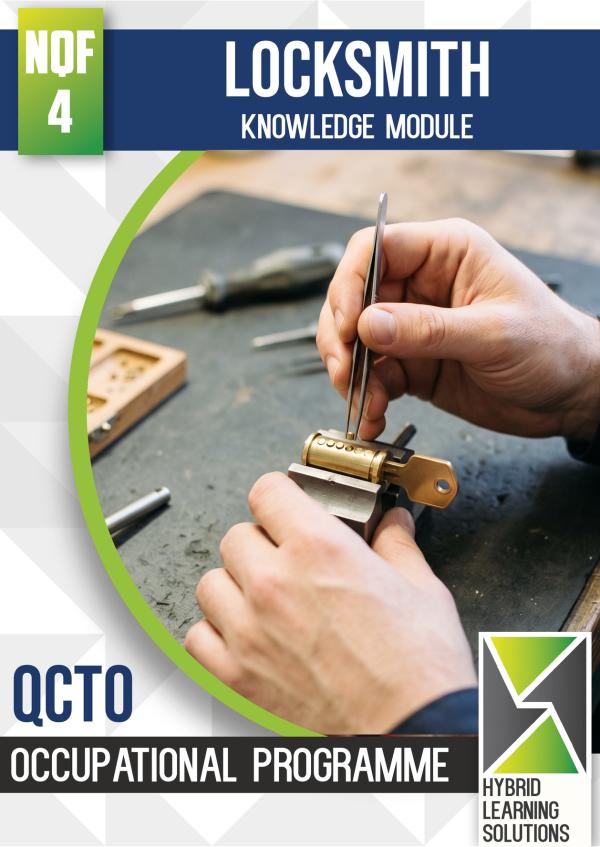
Locksmith - Knowledge Module
Hybrid Learning Solutions · e-book
R1100 incl. VAT
Printed copy: R2250 incl. VAT.
Read in any web browser, or in the HybridE app on Android.
About this book
The theory textbook for the QCTO Occupational Certificate: Locksmith (NQF Level 4, SAQA ID 116130). Seventeen chapters covering all 136 credits of the knowledge component: legislation, PSIRA registration and ethics; health and safety; trade tools and instruments; key duplicating principles; customer service; installing locks, with welding for the locksmith; maintaining and calibrating key machines; welding, brazing and silver soldering; master key systems; originating keys, opening locks, automotive locks and picking; opening and restoring non-categorised and categorised safes; duplicating keys with electronic machines; transponder coding through on-board diagnostics and by EEPROM; electronic locks and access control; and CCTV, gate motors and intercoms. Opening, safe and vehicle work is taught with the authority, records and legitimate routes to controlled data the trade requires. Includes the part qualification Key Cutter. Last date for enrolment on SAQA 116130 is 31 December 2026; last date for achievement is 31 December 2029.
- Level: NQF Level 4
- SAQA ID: 116130
- ISBN (e-book): 978-1-996787-98-4
- Pages: 702
What is inside
- Chapter 1 — Legislative Requirements in the Locksmithing Industry
- PART A — REGISTRATION REQUIREMENTS
- PART B — ETHICS AND PROFESSIONALISM
- Chapter 2 — Health and Safety in the Locksmith Trade
- PART A — THE LAW AND WHY ACCIDENTS HAPPEN
- PART B — GENERAL WORKSHOP SAFETY
- PART C — TOOLS AND EQUIPMENT
- Chapter 3 — Trade Tools and Instruments
- PART A — HAND TOOLS AND INSTRUMENTS
- PART B — POWER TOOLS
- PART C — TRADE RELATED SPECIFIC TOOLS AND INSTRUMENTS
- Chapter 4 — Key Duplicating Principles
- PART A — KNOWING THE KEY
- PART B — MANUAL KEY CUTTING MACHINES
- PART C — SAFETY AND ACCURACY
- Chapter 5 — Fundamentals of Customer Service
- PART A — COMMUNICATION SKILLS
- PART B — RESOLVING CUSTOMERS’ QUERIES
- Chapter 6 — Installation of Locks
- PART A — TYPES OF LOCKS AND THEIR USES
- PART B — INSTALLING LOCKS IN WOODEN DOORS
- PART C — INSTALLING LOCKS IN METAL DOORS, FRAMES AND GATES
- PART D — INSTALLING LOCKS IN ALUMINIUM DOORS
- PART E — WELDING AS IT APPLIES TO LOCKSMITHING
- Chapter 7 — Maintenance and Calibration of Key Machines
- PART A — THE MACHINES AND WHY THEY NEED CARE
- PART B — SAFE MAINTENANCE
- PART C — CALIBRATION
- Chapter 8 — Welding, Brazing and Silver Soldering
- PART A — ARC WELDING FOR THE LOCKSMITH
- PART B — BRAZING, SOLDERING AND SILVER SOLDERING
- PART C — WORKED EXAMPLES
- Chapter 9 — Master Key Systems
- PART A — HOW MASTER KEYING WORKS
- PART B — PLANNING AND DESIGNING THE SYSTEM
- PART C — FROM CHART TO CYLINDER
- PART D — SECURITY, CONTROL AND QUALITY
- Chapter 10 — Originating Keys, Opening Locks, Automotive Locks and Picking
- PART A — ORIGINATING KEYS
- PART B — OPENING LOCKS
- PART C — AUTOMOTIVE LOCKS
- PART D — PICKING
- Chapter 11 — Opening and Restoring the Security of Non-categorised Safes
- PART A — WHAT YOU ARE WORKING ON
- PART B — THE LOCKS
- PART C — OPENING
- PART D — RELOCKERS AND RESTORING SECURITY
- Chapter 12 — Duplicating Keys with Electronic Machines
- PART A — THE MACHINES
- PART B — CODE SOFTWARE AND CUTTING TO CODE
- PART C — TRANSPONDERS
- PART D — READING, CLONING AND THE EQUIPMENT
- PART E — AUTHORITY, RECORDS AND THE LAW
- Chapter 13 — Opening and Restoring the Security of Categorised Safes
- PART A — WHAT A CATEGORY MEANS
- PART B — AUTHORITY AND THE DECISION
- PART C — RESTORING AND DISCLOSING
- Chapter 14 — Transponder Coding Using On-Board Diagnostics
- PART A — THE SYSTEM YOU ARE WORKING ON
- PART B — THE EQUIPMENT
- PART C — CHIPS, MEMORY AND CODES
- PART D — PROGRAMMING
- PART E — REMOTE PROGRAMMING
- PART F — RISK, AUTHORITY AND JUDGEMENT
- Chapter 15 — Programming Transponders Using EPROM
- PART A — WHY AND WHAT
- PART B — THE EQUIPMENT
- PART C — LOCATING THE UNITS
- PART D — SOLDERING AND DE-SOLDERING
- PART E — THE SOFTWARE AND THE CYCLE
- PART F — RISK, AUTHORITY AND LIMITS
- Chapter 16 — Electronic Locks and Access Control
- PART A — ELECTRICAL FOUNDATIONS
- PART B — ELECTRONIC LOCKING DEVICES
- PART C — ACCESS DEVICES
- PART D — CABLES AND WIRING DIAGRAMS
- PART E — CONTROLLERS, SOFTWARE AND NETWORKS
- PART F — LAW, RECORDS, COMMISSIONING AND HANDOVER
- Chapter 17 — CCTV, Gate Motors and Intercom Systems
- PART A — CCTV SYSTEMS
- PART B — AUTOMATED GATES AND GARAGE DOOR MOTORS
- PART C — INTERCOM SYSTEMS