QCTO qualifications › Logistics Practitioner
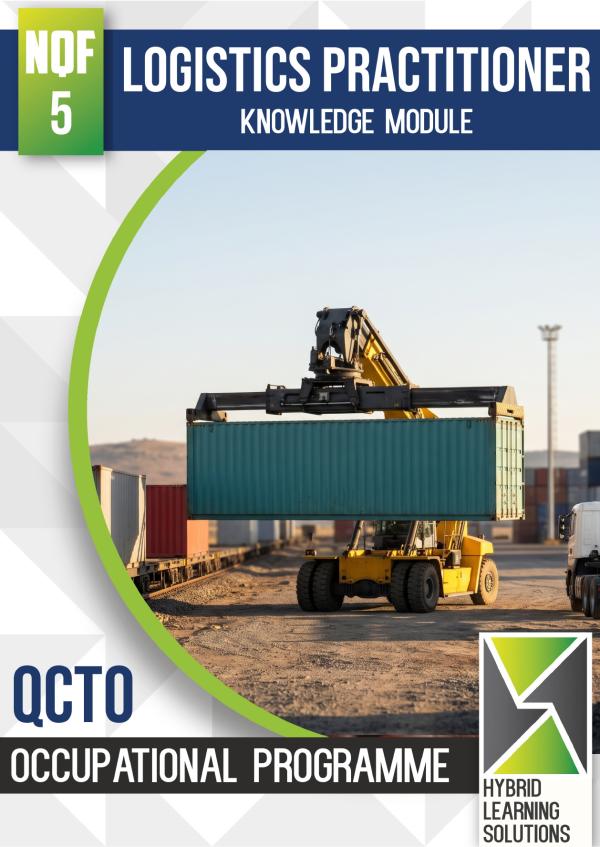
Logistics Practitioner - Knowledge Module
Hybrid Learning Solutions · e-book
R1100 incl. VAT
Printed copy: R2250 incl. VAT.
Read in any web browser, or in the HybridE app on Android.
About this book
The theory textbook for the QCTO Higher Occupational Certificate: Logistics Practitioner (NQF Level 5, SAQA ID 123402), TETA. Nine chapters covering the seven knowledge modules (53 credits): analytical thinking, innovation and complex problem solving; software and technology for logistics; transport modes and their costs; risk management and the law in transport and storage; storage of freight in warehouses, yards, depots, silos and stores; the cost of storage; and managing physical resources, human capital and financial resources. Every calculation was worked before it was printed, from vehicle costing and volumetric mass to EOQ, storage tariffs, staffing and budget variances, and the laws are as in force in November 2026. 21 figures, plus 82 Exam prep questions.
- Level: NQF Level 5
- SAQA ID: 123402
- Pages: 247
What is inside
- Chapter 1 — Analytical Thinking, Innovation and Complex Problem Solving
- PART A — CREATIVITY, ORIGINALITY AND INITIATIVE
- PART B — ANALYTICAL THINKING AND INNOVATION
- PART C — CRITICAL THINKING AND ANALYSIS
- PART D — COMPLEX PROBLEM SOLVING
- PART E — LEADERSHIP AND SOCIAL INFLUENCE
- Chapter 2 — Software and Technology for Logistics
- PART A — INTRODUCTION TO SOFTWARE UTILISATION
- PART B — THE SOFTWARE DEVELOPMENT AND IMPLEMENTATION LIFE CYCLE
- PART C — THE NEED FOR A SOLUTION
- Chapter 3 — Transport Modes
- PART A — THE MODES TOGETHER
- PART B — ROAD TRANSPORTATION
- PART C — RAIL TRANSPORTATION
- PART D — AIR TRANSPORTATION
- PART E — SEA TRANSPORTATION
- PART F — INLAND WATERWAY TRANSPORTATION
- PART G — CHOOSING AND COMBINING MODES
- Chapter 4 — Risk Management in Transport and Storage
- PART A — THE RISK MANAGEMENT PROCESS
- PART B — RISK MANAGEMENT FOR TRANSPORTATION
- PART C — RISK MANAGEMENT FOR STORAGE
- PART D — FISCAL RISK
- Chapter 5 — Storage of Freight
- PART A — TYPES OF STORAGE FACILITIES
- PART B — FREIGHT HANDLING EQUIPMENT
- PART C — STORAGE FACILITY STRUCTURAL LAYOUT
- PART D — MOVEMENT OF FREIGHT WITHIN A STORAGE FACILITY
- Chapter 6 — The Cost of Storage
- PART A — THE BUILDING BLOCKS OF STORAGE COST
- PART B — WAREHOUSES AND DISTRIBUTION CENTRES
- PART C — STOCKYARDS
- PART D — SILOS
- PART E — STORES
- PART F — TERMINALS
- PART G — COMPARING STORAGE OPTIONS
- Chapter 7 — Managing Physical Resources
- PART A — IDENTIFYING THE PHYSICAL RESOURCES REQUIRED
- PART B — MAINTENANCE SCHEDULES AND EMERGENCY REPAIRS
- PART C — LEGISLATIVE AND SECURITY REQUIREMENTS
- PART D — MONITORING UTILISATION AND CONDITION
- Chapter 8 — Managing Human Capital
- PART A — DETERMINING OPERATIONAL STAFF REQUIREMENTS
- PART B — SKILLS LEVELS AND TRAINING NEEDS
- PART C — CONTRACTUAL STAFF
- PART D — LABOUR AND SAFETY REQUIREMENTS FOR CONTRACTUAL EXECUTION
- Chapter 9 — Managing Financial Resources
- PART A — FORECAST BUDGETS
- PART B — MONITORING BUDGET UTILISATION
- PART C — FINANCIAL STATEMENTS
- PART D — JOURNAL ENTRIES