QCTO qualifications › Motorcycle Mechanic
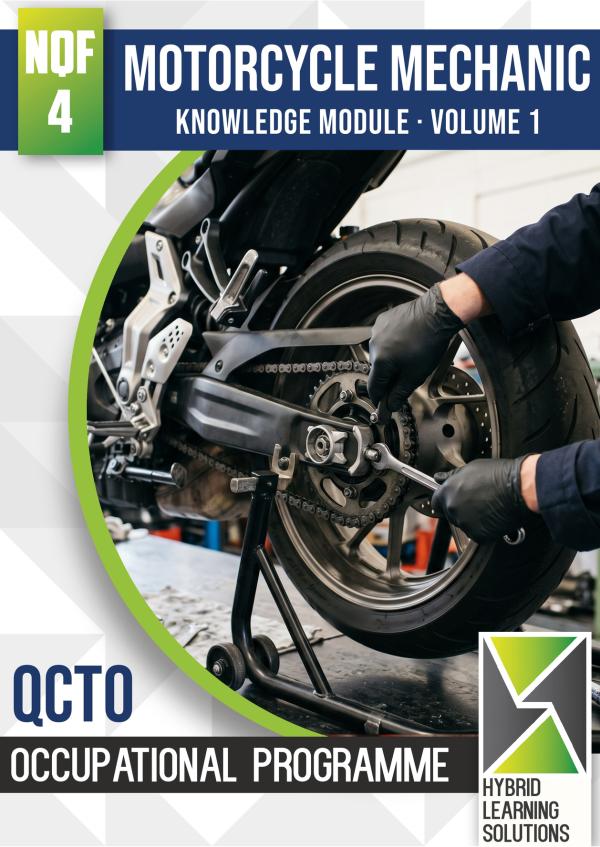
Motorcycle Mechanic - Knowledge Module, Volume 1
Hybrid Learning Solutions · e-book
R600 incl. VAT
Printed copy: R1200 incl. VAT.
Read in any web browser, or in the HybridE app on Android.
About this book
Volume 1 of the theory textbook for the QCTO Occupational Certificate: Motorcycle Mechanic (NQF Level 4, SAQA ID 97591) — the trade, the engine and the machine. Chapters 1 to 12 carry 55 of the knowledge component's 108 credits: the mechanic at work and workplace relationships; productivity, health and safety, ICT and ethics; the repair trade, servicing and maintenance; physics, engine principles and motorcycle construction; engine applications and alternative propulsion; fundamentals of electricity; fluids, lubricants, materials, bushes and bearings; lubrication, heating and cooling; induction and exhaust; tyres, wheels, suspension and steering; drive train, clutch and transmission; and stationary engine systems. Taught motorcycle-first throughout — singles, twins and multis, two-strokes, CVT scooters, and chain, belt and shaft final drives. Chapters are numbered continuously 1 to 20 across the two volumes. Last date for enrolment on SAQA 97591 is 30 December 2026; last date for achievement is 30 December 2029.
- Level: NQF Level 4
- SAQA ID: 97591
- Pages: 518
What is inside
- Chapter 1 — The Motorcycle Mechanic at Work: Employment, Organisation and Workplace Relationships
- PART A — EMPLOYMENT
- PART B — ORGANISATION OF WORK
- PART C — EMPLOYER-EMPLOYEE RELATIONSHIPS
- Chapter 2 — Performing Work Well: Productivity, Health and Safety, ICT, Ethics and Trends
- PART A — CONCEPTS RELATED TO THE PERFORMANCE OF WORK
- PART B — EMPLOYER ORGANISATIONS AND THE EXTERNAL ENVIRONMENT
- PART C — INFORMATION AND COMMUNICATION TECHNOLOGY AT WORK
- PART D — ETHICS AT WORK
- PART E — CURRENT TRENDS INFLUENCING WORK
- Chapter 3 — The Motorcycle Repair Trade, Servicing and Maintenance
- PART A — THE WORLD OF MOTORCYCLE REPAIR
- PART B — SERVICING AND MAINTENANCE
- Chapter 4 — Physics for Mechanics; Engine Principles and Motorcycle Construction
- PART A — PHYSICS FOR THE MECHANIC
- PART B — BASIC PRINCIPLES OF INTERNAL COMBUSTION ENGINES
- PART C — VEHICLE AND EQUIPMENT CONSTRUCTION
- Chapter 5 — Engine Applications and Alternative Propulsion: Electric, Hybrid, Hydrogen and LPG
- PART A — ADDITIONAL ENGINE APPLICATIONS
- PART B — ALTERNATIVE PROPULSION TECHNOLOGIES
- Chapter 6 — Fundamentals of Electricity
- PART A — WHAT ELECTRICITY IS
- PART B — CIRCUITS, DIAGRAMS AND COMPONENTS
- PART C — MEASURING, CALCULATING AND FINDING FAULTS
- PART D — MAGNETISM, CAPACITANCE AND ELECTRICITY ON THE MOTORCYCLE
- Chapter 7 — Fluids, Lubricants, Materials, Lubrication, Bushes and Bearings
- PART A — FLUIDS, LUBRICANTS, MATERIALS AND METALS
- PART B — LUBRICATION
- PART C — BUSHES AND BEARINGS
- Chapter 8 — Engine Lubrication, Heating and Cooling Systems
- PART A — ENGINE LUBRICATION SYSTEMS
- PART B — HEATING AND COOLING SYSTEMS
- Chapter 9 — Induction and Exhaust Systems
- PART A — THE INDUCTION SYSTEM
- PART B — THE EXHAUST SYSTEM
- Chapter 10 — Tyres, Wheels, Suspension and Steering
- PART A — TYRES AND WHEELS
- PART B — SUSPENSION
- PART C — STEERING, ALIGNMENT AND BALANCING
- PART D — LIMITATIONS, FAULTS, MAINTENANCE AND SAFETY
- Chapter 11 — Drive Train, Clutch and Transmission Systems
- PART A — THE DRIVE TRAIN
- PART B — THE CLUTCH
- PART C — THE TRANSMISSION
- Chapter 12 — Stationary Engine Systems
- PART A — THE STATIONARY ENGINE AND ITS DUTY
- PART B — COOLING SYSTEMS
- PART C — FRAMES, MOUNTINGS AND COUPLINGS
- PART D — CONTROL SYSTEMS
- PART E — NOISE, TEMPERATURE AND FIRE CONTROL
- PART F — SPECIFICATIONS, LIMITATIONS, FAULTS, MAINTENANCE AND SAFETY