Skills books › Using AI Assistants at Work and at Home: Writing, Research, and Staying Safe and Honest
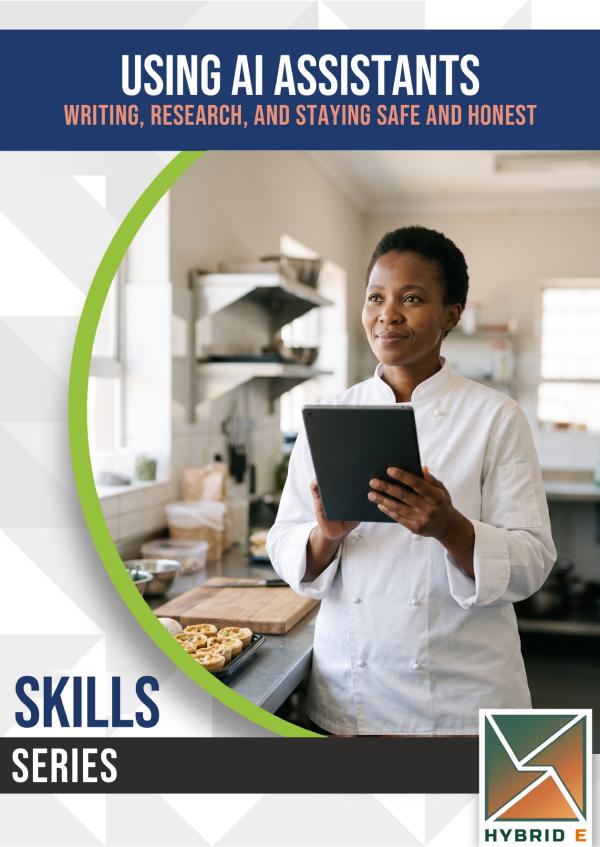
Using AI Assistants at Work and at Home: Writing, Research, and Staying Safe and Honest
Hybrid Learning Solutions · e-book
R195 incl. VAT
Read in any web browser, or in the HybridE app on Android.
About this book
Curious about AI assistants, or worried about them? This book shows you how to use them well, safely and honestly, in plain language: to write, research, learn and save time at work and at home, while checking the facts, protecting your privacy and spotting the new scams.
Who it is for
- Anyone who is curious, or worried, about AI assistants.
- Office workers and small-business owners who want to save time without making mistakes.
- Students who want to study better without breaking their college's rules.
- Parents who want to set sensible rules at home.
- Colleges, employers and community groups. Lecturers and trainers get a free Facilitator Guide.
What you will learn
- What AI assistants are, what they are good at, and where they go wrong.
- How to ask clearly, and get a far better first answer.
- Writing emails, letters, CVs and posts that still sound like you.
- Checking facts, references and numbers, because assistants can be confidently wrong.
- Summarising, translating and learning, and when to ask a person instead.
- Using assistants at work within the rules, and what never to type in.
- Honesty in study and at work, and saying when AI helped.
- Spotting fake voices, deepfakes and AI-written scams, and what to do.
- Bias, judgement, and how work is changing.
The people in the book
- Busisiwe, in Mbombela, runs a small catering business.
- Johan, in Paarl, an office manager who has to write his company's rules on AI.
- Ayesha, in Cape Town, a TVET college student.
- Dr Moloi, a librarian in Mahikeng, gives a Librarian's Note in every chapter.
What is in the book
- 12 chapters in plain, short sentences, with 12 diagrams.
- Worked examples, with every sum shown, and practice exercises with answers.
- An AI toolkit: request templates, a fact-check record, a privacy checklist, a disclosure note, a scam-check card, family rules, workplace policy questions and your personal rules.
- 144 practice questions in the app.
This book names no AI assistant, company, phone or software brand: the skills work with any of them. It does not teach building AI tools or coding, it is not legal advice, and it is not a qualification. For computer basics, see Computer Skills for Everyday Life; for scams in general, see Staying Safe Online.
For lecturers and trainers
A free Facilitator Guide, with session plans for a 25-hour course or a 1-day staff workshop, teaching notes and every answer, is available to colleges registered with HybridE. To register your college, contact Thandeka on 073 431 6763.
Includes your business file: the book's worksheets as a printable PDF and an Excel workbook, to download once the book is yours.
What is inside
- Chapter 1: Getting Started
- Chapter 2: Asking Well
- Chapter 3: Writing with an Assistant
- Chapter 4: Research and Checking Facts
- Chapter 5: Summarising, Translating and Learning
- Chapter 6: Everyday Life at Home
- Chapter 7: At Work
- Chapter 8: Privacy and Personal Information
- Chapter 9: Honesty: Study, Work and Copyright
- Chapter 10: Scams, Fakes and Deepfakes
- Chapter 11: Bias, Mistakes and Judgement
- Chapter 12: Going Further
- Appendices: Your AI Toolkit