
Skills books › Water Backup for Your Home in South Africa: Tanks, Storage and Safe Water When the Taps Run Dry
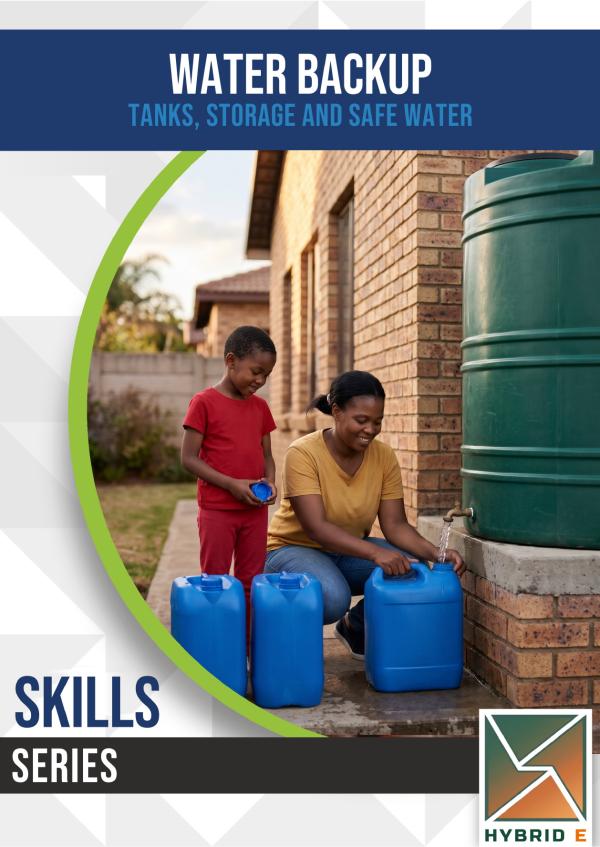
Water Backup for Your Home in South Africa: Tanks, Storage and Safe Water When the Taps Run Dry
Hybrid Learning Solutions · e-book
R195 incl. VAT
Read in any web browser, or in the HybridE app on Android.
About this book
Tired of the taps running dry? This book shows you how to keep your household in safe water when the municipal supply stops, in plain language: how much water you need, storing and treating drinking water, choosing a tank, safe bases and stands, pumps and pressure, connecting backup safely, rainwater top-ups, getting through an outage, looking after your water, and the costs and your plan.
Who it is for
- Families who keep losing water to maintenance, burst pipes, load-shedding or drought.
- Homeowners thinking about a tank, with or without a pump, and wanting to buy and install it properly.
- Tenants and people in flats who can only store containers, and need to do it safely.
- Retired people and anyone caring for babies, older people or someone who is ill.
- Community groups, clinics, ward committees, bodies corporate and colleges. Lecturers and trainers get a free Facilitator Guide.
What you will learn
- Why the water goes off, and the backup options, from containers to a pumped tank.
- How much water a household needs, at 25 litres a person a day, and how long your water will last.
- Storing drinking water safely: the right containers, sanitising, dating and rotating them.
- Making water safe to drink by boiling, or with the right dose of plain household bleach, and the danger signs that mean a clinic.
- Choosing a tank: its size, colour and weight, where it can stand, and the rules to check first.
- Level bases, safe stands, and how little pressure height gives.
- Pumps, pressure vessels and what happens in a power cut.
- Connecting backup to the house safely: backflow, a registered plumber, a Certificate of Compliance, and comparing quotes.
- Rainwater to top up your tank, with screens and a first-flush device.
- Getting through an outage day hygienically, and what to do when the water comes back.
- Looking after your tank, keeping mosquitoes out, and keeping small children safe around water.
- Costs, landlords and bodies corporate, shared systems, and a one-page household water plan.
The people in the book
- Thandi Mokoena, 38, in Roodepoort, keeps her family of five going with containers and a 2 000-litre tank.
- Pieter and Annelie van Wyk, retired, in Pretoria East, have a 5 000-litre tank with a pump.
- Sipho Ndlovu, 29, rents a flat in Durban and stores water in containers.
- Mr Rajen Govender, a registered plumber in Pietermaritzburg, gives a Plumber's Note in every chapter.
What is in the book
- 12 chapters in plain, short sentences, with 12 diagrams and 10 photographs.
- Worked examples, with every sum shown, and practice exercises with answers.
- A household water toolkit: household water needs, a stored water and rotation log, a safe water treatment card, tank sizing and rainwater, a shopping list and supplier questions, comparing plumbers' quotes, an installation checklist, a maintenance log, an outage-day plan, contacts, a letter to a landlord or body corporate, and a one-page household water plan.
- 144 practice questions in the app.
The book teaches and does not advise: it does not make you a plumber, electrician or engineer, and it does not diagnose illness. Connecting a tank to the house is a registered plumber's work, wiring a pump a registered electrician's, and a tank stand the maker's or an engineer's. The law is described in general terms as at November 2026, so check the rules with your own municipality. The book names no brands, products, shops or apps, and every price is an invented example. See also Water-Wise Gardening, Cutting Your Electricity and Water Bills and Solar Backup Power for Your Home.
For lecturers and trainers
A free Facilitator Guide, with session plans for a 20-hour course or a 3-hour safe water workshop, teaching notes and every answer, is available to colleges registered with HybridE. To register your college, contact Thandeka on 073 431 6763.
Includes your business file: the book's worksheets as a printable PDF and an Excel workbook, to download once the book is yours.
What is inside
- Chapter 1: Water Cuts and Your Options
- Chapter 2: How Much Water You Need
- Chapter 3: Storing Drinking Water Safely
- Chapter 4: Making Water Safe to Drink
- Chapter 5: Choosing a Water Tank
- Chapter 6: Bases, Stands and Height
- Chapter 7: Pumps and Pressure
- Chapter 8: Connecting Backup to the House
- Chapter 9: Rainwater to Top Up Your Tank
- Chapter 10: Getting Through an Outage
- Chapter 11: Looking After Your Tank and Water
- Chapter 12: Costs, Neighbours and Your Plan
- Appendices: Your Household Water Toolkit