NATED textbooks › Chemical
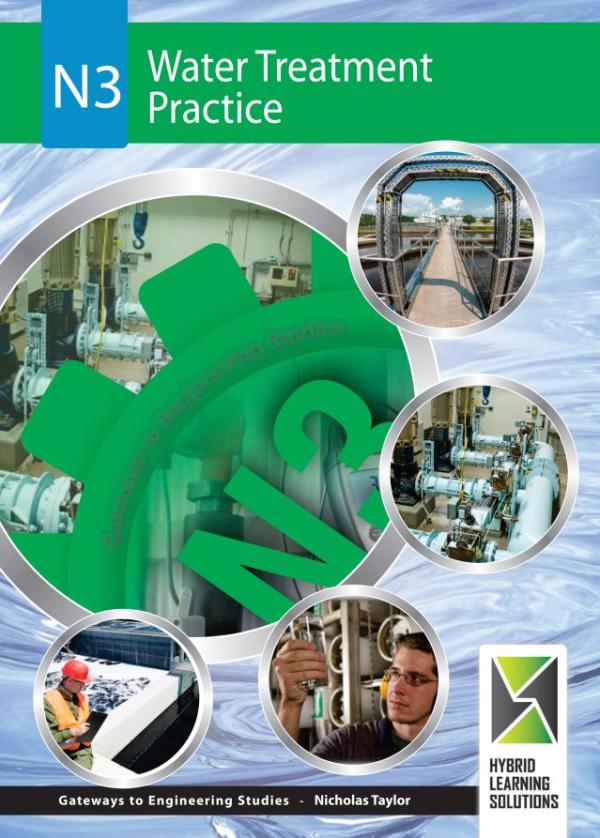
Water Treatment Practice N3
N. Taylor · e-book
R225.75 incl. VAT
Printed copy: R334.95 incl. VAT.
Read in any web browser, or in the HybridE app on Android.
About this book
The NATED N3 textbook for Water Treatment Practice. By N. Taylor, published by Hybrid Learning Solutions.
- Level: N3
- ISBN (e-book): 978-1-928392-25-5
- ISBN (print): 978-1-928203-65-0
- Pages: 250
What the book covers
The topics in this book include:
- Module 1: Application of the SI; Elementary calculations; Formulae; Different units of volume measurement in water industry; Graphs; Concentrations.
- Module 2: Water and other liquids; Flow velocity versus flow rate; Hydrostatic pressure; Flow in pipes; Flow in channels; The syphon; Flow measurement and metering.
- Module 3: Driving force and power; Pump types and uses; Operation of pumps; Selection of pumps.
- Module 4: What is a valve?; Types of valves; Operation, maintenance, safety regulations and precautions; Records.
- Module 5: General chemistry; Organic and inorganic compounds; Cations and anions occurring in water; Oxidation and reduction; Dissociation, ionisation, H+, OH-, Acids, Bases and pH; Alkalinity and buffer capacity; Concentration of chemical reagents, mole versus normality; Adsorption.
- Module 6: Microorganisms; Types of micro organisms; Aquatic plants; Pollution detection: Escherichia coli as pollution index; Nutrients.
- Module 7: Legislation; Provincial ordinances and local by-laws; Requirements for domestic water; Requirements for wastewater effluent.
- Module 8: Natural water sources; Types of water; Water sources.
- Module 9: Water quality; Purpose of water purification; Pollution of water sources: domestic and industrial; Impurities found in water; Terminology regarding impurities in water; Physical requirements; Chemical requirements; Toxic substances.
- Module 10: Pre-sedimentation: Removal of grit and sand; Removal of tastes and odours; Removal of algae; Removal of iron and manganese; Flow measurement.
- Module 11: Destabilisation of colloidal particles; The process; Excess lime process; Reasons for post-precipitation; Dosing equipment; Laboratory jar tests.
- Module 12: Principals of sedimentation; Common problems; Types of sedimentation tanks; Vertical flow sedimentation tank; Radial flow sedimentation tank; Calculations; Sludge draw-off; Control and records.
- Module 13: Slow sand filters; Rapid gravity sand filter; Pressures sand filters; Other types of filters; Operational problems; Bringing a new filter into operation; Care of sand filters.
- Module 14: Purpose and principles; Methods; Theory of chlorination and factors affecting it; Formation of chlorinated compounds producing tastes and odours; Use of chlorines in distribution systems; Properties of chlorine gas and hypochlorites; Storage, handling and changing of chlorine cylinders; Gas chlorinators.
- Module 15: Corrosion and anti-corrosion measures; Precautions against corrosion; Cathodic protection; Stabilisation of water; Maintenance; Sampling at various points for residual chlorine and bacteria; Shock disinfection after repairs.
- Module 16: Softening; Anion exchange for nitrate removal; Desalination; Fluoridation; Defluoridation.
- Module 17: Sources of wastes in water treatment; Dewatering; Water recovery; Chemical recovery.
- Module 18: Occupation health and safety act and regulations (OHASA); Hazardous chemicals and gases; Fire and explosion hazards; Colour coding for rapid identification; Elementary First Aid; Ablution facilities.