QCTO qualifications › Office Administrator
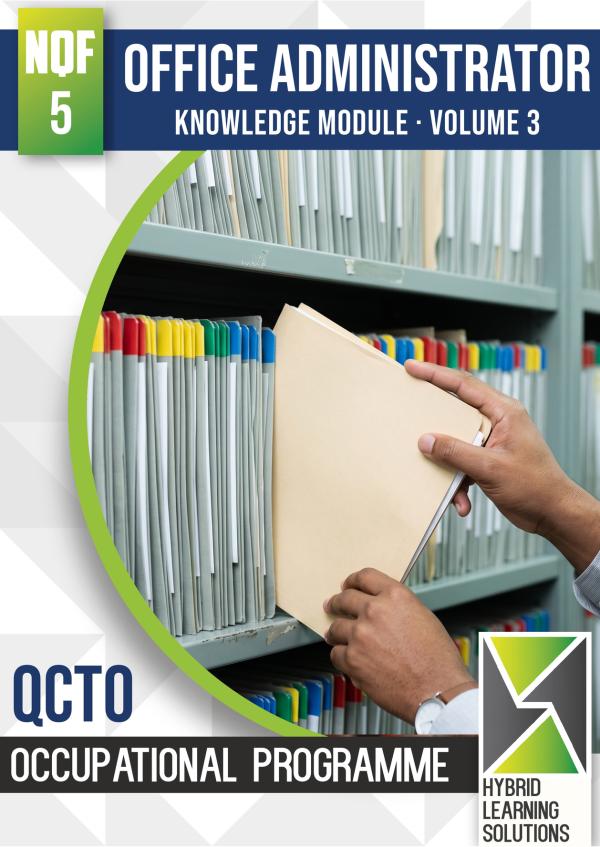
Office Administrator - Knowledge Module, Volume 3
Hybrid Learning Solutions · e-book
R600 incl. VAT
Printed copy: R1200 incl. VAT.
Read in any web browser, or in the HybridE app on Android.
About this book
Volume 3 of the theory textbook for the QCTO Occupational Certificate: Office Administrator (NQF Level 5, SAQA ID 102161) — people, development and projects. Chapters 14 to 20 cover staffing and people support; the NQF, skills development and the Workplace Skills Plan; public relations, marketing and advocacy; introductory project management across three chapters; and computerised project management. This volume also carries the review question bank: 485 questions set against every internal assessment criterion in the fifteen knowledge modules.
- Level: NQF Level 5
- SAQA ID: 102161
- Pages: 391
What is inside
- Chapter 14 — Staffing and People Support
- PART A — SELECTION AND SHORTLISTING
- PART B — INDUCTION
- PART C — HEALTH AND WELLNESS IN THE ORGANISATION
- PART D — PAYROLL AND SUPPORT SERVICES
- Chapter 15 — Principles of the NQF, Skills Development and the Workplace Skills Plan
- PART A — THE STATUTORY FRAMEWORK AND THE NQF
- PART B — SKILLS PLANNING
- PART C — FINDING THE SKILLS GAPS
- Chapter 16 — Public Relations, Marketing and Advocacy
- PART A — PUBLIC RELATIONS
- PART B — INTRODUCTION TO MARKETING
- PART C — INTEGRATED MARKETING COMMUNICATIONS
- Chapter 17 — Introductory Project Management I: Context, Life Cycle and Structures
- PART A — WHAT A PROJECT IS
- PART B — THE PROJECT LIFE CYCLE
- PART C — MANAGEMENT STRUCTURES
- Chapter 18 — Introductory Project Management II: Planning, Scope and Scheduling
- PART A — PLANNING THE PROJECT
- PART B — SCOPE MANAGEMENT
- PART C — SCHEDULING AND RESOURCE MANAGEMENT
- Chapter 19 — Introductory Project Management III: Risk, Quality, Communication and Leadership
- PART A — RISK AND ISSUE MANAGEMENT
- PART B — PROJECT QUALITY MANAGEMENT
- PART C — COMMUNICATION
- PART D — LEADERSHIP AND TEAMWORK
- Chapter 20 — Computerised Project Management
- PART A — THE COMPUTERISED PROJECT-PLANNING TOOL
- PART B — ACCESSING THE SCOPE, AND SETTING UP THE PROJECT
- PART C — THE SCHEDULING ENGINE
- PART D — THE LIFE CYCLE AND DECOMPOSITION
- PART E — DEVELOPING THE PROJECT PLAN
- PART F — ADMINISTERING AND MONITORING THE PROJECT
- Review Question Bank
- PART A — BY CHAPTER AND CRITERION
- PART B — INTEGRATED QUESTIONS
- PART C — THE FOUR SUBJECTS THE CURRICULUM REQUIRES AND DOES NOT TEACH